
Dashboard Warning Lights Explained: Which Ones Mean Stop
We have written about the engine management light before, because it is the one people ask about most. But a modern car has dozens of warning lights, and knowing which ones mean "pull over now" and which mean "book it in this week" is genuinely useful. Here is a guide to the ones you are most likely to see.
The colour rule
Warning lights follow a traffic-light convention. Red means a serious problem or a safety issue: stop as soon as it is safe to do so. Amber or yellow means something needs attention but the car can normally be driven carefully to a garage. Green or blue lights are just telling you that something is switched on, like the main beam or the fog lights.
Red lights: stop
- Oil pressure (an oil can). The engine has lost oil pressure. Stop immediately and switch off. Do not "just get home". An engine run without oil pressure can be destroyed in a minute or two. Check the oil level once it is safe to; if it is fine, do not restart the engine and call for recovery.
- Engine temperature (a thermometer in liquid). The engine is overheating. Pull over, switch off and let it cool. Do not open the coolant cap while it is hot. Check the level when it is cold. If it is low, something is leaking.
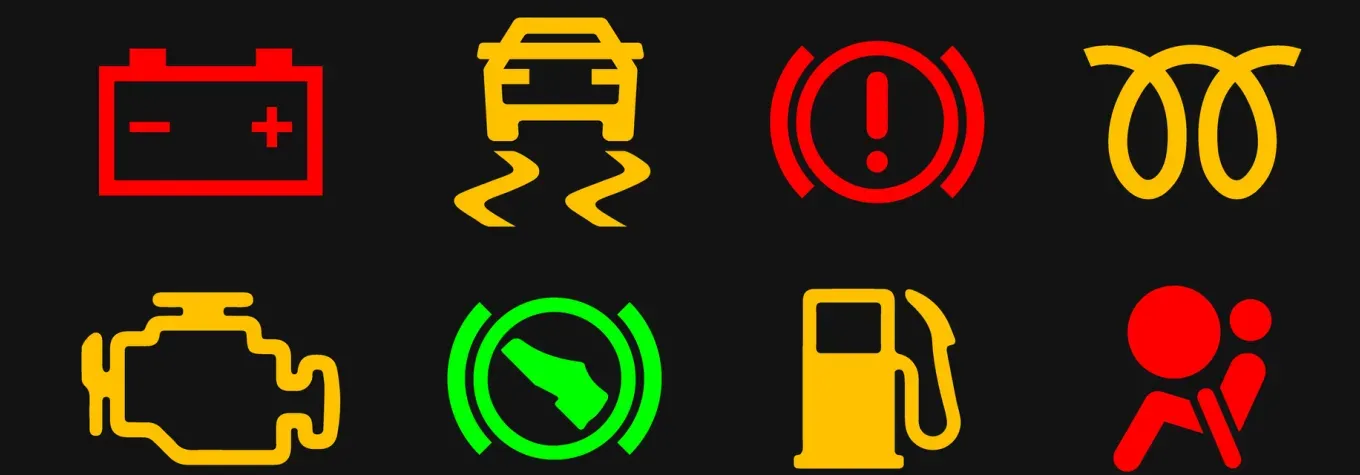
- Battery or charging (a battery symbol). The alternator has stopped charging. The car is running on the battery and will stop when it is flat, which on a modern car can be a matter of minutes. Switch off everything you can and get to a garage or home.
- Brake warning (a circle with an exclamation mark, or "BRAKE"). Either the handbrake is on, the brake fluid is low, or there is a fault in the braking system. If the handbrake is off and the light is on, stop and check the fluid. Low brake fluid usually means worn pads or a leak.
- Power steering. If the steering suddenly becomes heavy and the light comes on, the assistance has failed. The car can still be steered but it takes a lot more effort, especially at low speed.
Amber lights: get it checked
- Engine management (an engine outline). A fault has been logged by the engine management system. If the car is driving normally, book a diagnostic. If it is flashing, or the car is misfiring or down on power, stop: a flashing light usually means a misfire that can damage the catalytic converter.
- ABS. The anti-lock braking has a fault. Your normal brakes still work, but the anti-lock function does not, so brake earlier in the wet. It is an MOT failure.
- Traction or stability control (a car with wavy lines). If it flashes while you are driving, the system is working and you are on a slippery surface. If it stays on, there is a fault.
- Tyre pressure (a flat tyre with an exclamation mark). One or more tyres is under-inflated. Check them as soon as you can. If the light comes on suddenly while driving, you may have a puncture.
- Airbag (a seated figure with a circle). A fault in the airbag or seat belt pretensioner system. The airbags may not deploy in a crash. This is an MOT failure and should be looked at promptly.
- DPF (a box with dots). The diesel particulate filter needs to regenerate. Take the car for a twenty-minute run at speed. See our DPF post for the full story.
- Glow plugs (a coil). On a diesel, this shows while the glow plugs warm up before starting. If it stays on or flashes while driving, there is a fault.
- Low fuel, low washer fluid, service due. Self-explanatory, and not something to ignore just because they are yellow.
What to do when a light comes on
Note which light it was and what the car was doing at the time. Do not disconnect the battery to "reset" it: that clears the stored fault code, which is exactly the information we need to find the problem. If it is red, stop. If it is amber, book a diagnostic check and we will read the codes and tell you what it is before any work is done.
Book online at bestgarages.co.uk or call your nearest branch: Newport on 01983 533360, Lymington on 01590 674776, or Fordingbridge on 01425 561504.